Date
November 6, 2026
November
06
MSU Henry Center
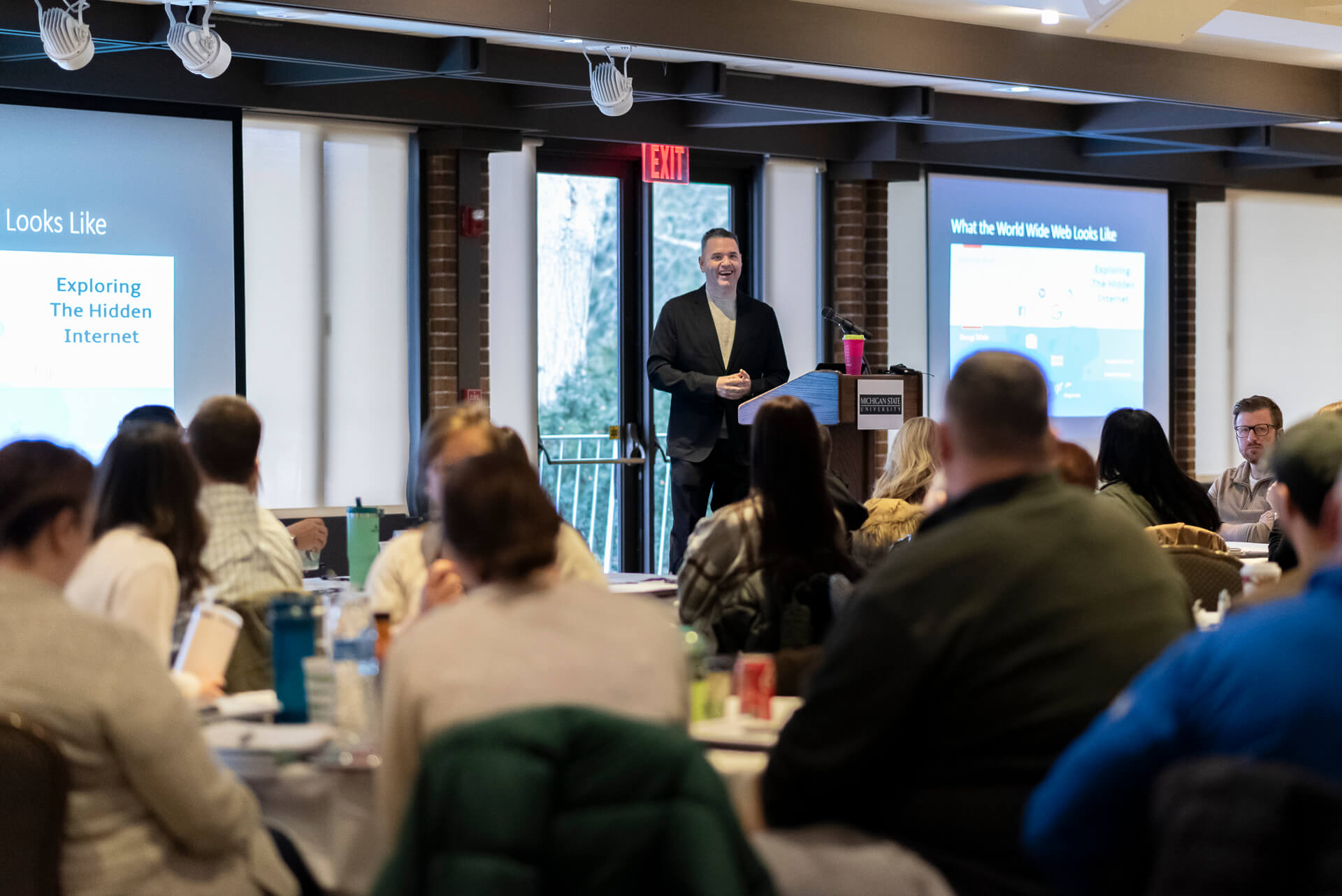
The Technology and Criminal Justice Summit, which will focus on sharing information between research and practice on various aspects of technology and the criminal and juvenile justice system. The event will bring experts from across different fields to present their work on issues ranging from Artificial Intelligence and body worn cameras to digital evidence collection and analysis.
The summit is approved for 8 hours of credit with MCOLES for practitioners.
Reserve your seat for the Summit!
From Evidence to Intelligence: Putting NIBIN to Work: The Role of the Crime Gun Intelligence Center in Maximizing the Tactical and Strategic Value of NIBIN
The National Integrated Ballistic Information Network (NIBIN) provides law enforcement with a powerful tool for connecting firearm evidence across incidents and generating leads that can advance shooting investigations. But the value of NIBIN does not end with the investigative lead. Ballistic intelligence can also be leveraged strategically to better understand patterns of firearm violence and inform responses to them. When integrated within a Crime Gun Intelligence Center (CGIC), NIBIN becomes part of a broader intelligence process that serves as a force multiplier.
This presentation introduces NIBIN and the CGIC model and explores their value at two levels: the tactical and strategic. Drawing on research and examples from Detroit, the presentation illustrates both applications, including evidence on the relationship between CGIC integration and shooting case outcomes, the role of gunshot detection technology in generating downstream crime gun intelligence, and the identification of near-repeat patterns in shootings.
Bio: Dr. Alaina De Biasi is an Assistant Professor in the Department of Criminology and Criminal Justice at Wayne State University. Her research interests include understanding the causes and consequences of firearm violence, leveraging law enforcement data systems to advance crime gun intelligence, evaluating the effectiveness of violence prevention initiatives, conducting community-engaged research, and exploring the geography of crime. Through her work, she seeks to develop new and better policies and practices aimed at violence prevention.
Technological Innovation and Violence Prevention and Control
Rapid technological innovation is affecting policing and community crime prevention strategies. This presentation focuses on some of the key technological developments that have become part of strategies to prevent and reduce violent crime. To date, the research evidence on the impact of many of these technologies is limited, though some promising findings have emerged. A key takeaway is that the impact of technology on violent crime reduction is most likely to be found when technology is integrated in more comprehensive violent crime reduction strategies.
Bio: Dr. Ed McGarrell’s primary research interest is in communities and crime and the development of evidence-based strategies for violence reduction. Much of this work involves research to understand local violent crime patterns, the translation of research to practice, and the evaluation of the impact of violence prevention and control strategies. McGarrell has had the good fortune to work collaboratively with a number of policing agencies including the Spokane Police Department, Indianapolis Metropolitan Police Department, and with the Detroit, Flint, and Lansing Police Departments, as well as with the Michigan State Police.
McGarrell leads the U.S. Department of Justice, Bureau of Justice Assistance’s Project Safe Neighborhoods and Smart Suite training and technical assistance programs that involve the translation of research to practice through researcher-practitioner partnerships. This research and collaboration was recognized with the Excellence in the Field of Criminal Justice Award, Bureau of Justice Assistance, U.S. Department of Justice (2024). McGarrell is the 2024 recipient of the College of Social Science Lifetime Achievement Award for Teaching, Research, and Service as well as a 2017 recipient of the William J. Beal Outstanding Faculty Award, Michigan State University. He is a Fellow of the Academy of Experimental Criminology, the recipient of the Distinguished Scholar Award, Division of Policing, American Society of Criminology, and the O.W. Wilson award for contributions to policing research, Police Section, Academy of Criminal Justice Sciences. He received the Jerry Lee Lifetime Achievement Award from the Division of Experimental Criminology (ASC), the Distinguished Achievement Award in Evidence-Based Crime Policy from the Center for Evidence-Based Crime Policy, George Mason University, and the Mentor Award of the Academy of Criminal Justice Sciences.
Mind the Gap: From Cybercrime Reporting to Digital Investigations
Cybercrime presents unique challenges for local law enforcement, but gaps in response may also reinforce the conditions that make these crimes difficult to address. This presentation considers how agencies can help disrupt this cycle through accessible, practical strategies such as community awareness, documenting cybercrime complaints, and strengthening investigative capabilities. Particular attention is given to low-cost open-source intelligence (OSINT) tools that can support digital investigations across cybercrime and traditional offenses, helping agencies better respond to crime in an increasingly digital environment.
Bio: Dr. Rachel McNealey is an Assistant Professor of Criminal Justice with her Ph.D. in criminology from Penn State University. Her research focuses on cybervictimization events and cyberoffending behavior, with the goal of tying new forms of crime to traditional theories of crime. Her work has been published in the Journal of Crime and Justice, the Journal of Interpersonal Violence, and the Journal of Research in Crime and Delinquency. Her non-academic experience includes working in the digital forensics lab at the Joint Electronic Crimes Task Force in Tuscaloosa, Alabama as well as their Network Intrusion Lab and security group Project Halo. As an early career scholar, her work aims to investigate emerging forms of crime with established methods and theories to produce actionable, practice-oriented findings.
Bio: Cooper A. Maher (Ph.D., School of Criminal Justice, University of Cincinnati) is an Assistant Professor in the School of Criminal Justice at Michigan State University. His research interests center upon understanding victimization risk factors, consequences, and victimization decision making within the context of fraud, identity theft, and online victimization more generally. His research has been published in various criminological journals, including the American Journal of Criminal Justice, Criminal Justice and Behavior, and the Journal of Criminal Justice.
The Investigative Value of Forensic Hand Imagery in Child Sexual Abuse Material
Digital evidence is estimated to be a factor in about 90% of criminal cases, and mobile phones are the most seized devices. The popularity of smartphones has also increased the ease of sharing high-quality multimedia via social media and native texting. In CSEA criminal cases, images and videos can serve as important forms of digital evidence – whether it is a “sext” sent from the offender to the victim, or child sex abuse material created by the offender. Although the offenders conceal their faces, other biometric features are present, including the dorsal side of the hand, and research has shown that knuckles and fingernail beds are valid forms of unique biometrics for identification. This presentation will discuss the research and development of the Suspect Hand Biometrics Tool – a digital forensics tool that automatically processes images and videos to extract knuckle and fingernail bed biometrics. In addition, cases will be presented that outline the process for conducting and presenting forensic hand comparisons in court as evidence. Finally, we will include recommendations for collecting comparison and exemplar imagery for law enforcement investigations requiring forensic hand comparisons.
Bio: Dr. Kate Seigfried-Spellar is a Professor in the School of Criminal Justice at Michigan State University and a Center Associate with the MSU Center for Cybercrime Investigation and Training. Dr. Seigfried-Spellar also has special deputy status with the Ingham County Sheriff’s Office to assist with their child sexual exploitation and abuse investigations involving digital evidence. She received her BA in Psychology and Law & Society from Purdue University, an MA in Forensic Psychology from John Jay College of Criminal Justice, and her PhD in Technology with concentrations in digital forensics and psychology from Purdue University. She is a renowned expert in the psychosocial and technological factors associated with cybercriminal behavior, specifically on the criminological characteristics and grooming strategies of online child sex offenders. Her research intersects multiple fields, including the behavioral sciences, social sciences, artificial intelligence, biometrics, natural language processing, and digital forensics. She is a Fellow and Chair of the Ad Hoc Committee on Vicarious Trauma and the former Chair of the Digital and Multimedia Sciences section of the American Academy of Forensic Sciences. She is a member of the American Psychological Association, the International Association of Law Enforcement Intelligence Analysts, and the International Association for Identification.
Bio: Aaron Roberts is currently a Digital Forensic Analyst with the Michigan State Police, specializing in computer forensics since 2018. He has worked in the field since 2015 and received his CFCE (Certified Forensic Computer Examiner) in 2016. Before working for the Michigan State Police, he was a sworn law enforcement officer for just over 20 years, ending his career as a detective, with much of that time spent as an evidence technician. As a digital forensic analyst, he routinely performs comparative analyses of data sets, including creating documents and other demonstrative evidence to assist in determining the attribution of specific individuals to artifacts seized from devices. Mr. Roberts is qualified as an expert witness in computer and mobile forensics in several counties in lower Michigan. He has presented comparative analyses for attribution, including partial hand analysis in court during a trial for CASM and CSC, which helped lead to a successful prosecution. He is currently a member of the International Association of Computer Investigative Specialists and has authored various scripts and tools to assist with forensic analyses.
Harnessing Python and Artificial Intelligence for Public Safety
Public safety operations routinely engage in data-driven decision-making to produce the most effective and efficient use of resources possible. A number of off-the-shelf software products have made engaging in such practices easier through prepackaged analyses and outputs that can be fully integrated into law enforcement operations. These products, however, can be costly and include features not tailored to specific law enforcement contexts. The advent of flexible computer programming languages and artificial intelligence has created the opportunity to build data and analysis systems that can provide public safety agencies with the capabilities needed to run effectively, without the high costs, restrictive contracts, and data retrieval challenges associated with commercial software. In this presentation, we provide examples of data analysis tools created using the Python programming language and enhanced through artificial intelligence, including flexible hot spot maps, offender record lookup and social network tools, along with risk terrain models that identify potential crime generators and prevention resources in the local environment. We discuss the potential for these tools to be used widely across law enforcement and public safety offices of all sizes.
Date
November 6, 2026
Time
8:30 AM - 5:00 PM
Location
MSU Henry Center
FREE
Organizer
MSU Center for Cybercrime Investigation & Training