Michigan State University has long been recognized as a premier institution for research and education in forensic science, and is home to a number of excellent resources for the study of forensic science.
The School of Criminal Justice maintains modern laboratory facilities containing equipment and instrumentation for the analysis of virtually any type of physical evidence, from chromatography equipment for drugs, explosives, and arson evidence, to microscopy techniques for trace evidence analysis.
The Forensic Science Masters program at Michigan State University is designed to give students a broad theoretical and practical background in the scientific, legal, and investigative aspects of forensic science while providing the opportunity to study one of the major disciplines in depth.
The Master of Science in Forensic Science Program includes courses in criminal justice, forensic science, and law, with a focus on forensic chemistry. Throughout the program, students are required to take core classes in both forensic science and chemistry. This allows students to further their knowledge of chemistry while using that knowledge in forensic applications.
Research in the forensic sciences takes place throughout a student's time in the program. We place a strong emphasis on research, with each student conducting an independent research project that culminates in a written thesis and oral defense. Conducting research allows students to develop the independence and critical thinking skills that are essential for any forensic scientist.
Students are provided with funding to present their research at local and national forensic science conferences, giving them public speaking and networking opportunities. In addition, students are strongly encouraged to publish their research in peer-reviewed journals.
Although not required, internships are strongly encouraged to provide students the opportunity to gain first-hand experience in the day-to-day workings of forensic laboratories. In recent years, students have conducted internships with the Michigan State Police Forensic Science Division, the State of Michigan Department of Health and Human Services, and the Kalamazoo County Sheriff Department.
Mission
The mission of the Master of Science in Forensic Science Program at Michigan State University is to bring together the University's varied forensic science resources in order to provide a state of the art graduate level education in forensic science to outstanding students who have achieved a bachelors degree in a natural or physical science and who are highly motivated to enter a career in forensic science.
Goals and Objectives
- To take advantage of the many diverse forensic science faculty and laboratory resources available at MSU in order to develop an intellectual environment that will promote the growth of education and research in forensic science
- To provide a hands-on, research-intensive experience for students that will better prepare them for a career in laboratory-based science
- To facilitate the attainment of a comprehensive and contemporary Master of Science in Forensic Science degree by graduate students at MSU
- To prepare graduate students for their future professional responsibilities
Meet the Director
Ruth Smith obtained her Ph.D. in Forensic and Analytical Chemistry in 2003 from the University of Strathclyde, Glasgow, Scotland. She was then a postdoctoral fellow in the Analytical Chemistry Group at Los Alamos National Laboratory, New Mexico, where she worked on improving methods for the detection of explosives. In 2005, she moved to Michigan State University to coordinate the forensic chemistry concentration, and became director of the Forensic Science Program in 2018. She teaches graduate-level courses in controlled substance identification and trace evidence analysis.
Her research interests focus on the application of new and emerging analytical techniques to the forensic sciences, as well as the application of multivariate statistical procedures for the association and discrimination of various types of forensic evidence. Her work has been published widely in forensic science and analytical chemistry journals and has mentored more than 30 M.S. students. She is a Fellow of the American Academy of Forensic Sciences, serves as associate editor for forensic chemistry for the Journal of Forensic Sciences, and serves on the editorial board for Forensic Chemistry. She is also a member of the Organization of Scientific Area Committees (OSAC) for Forensic Science Seized Drugs Subcommittee and a core committee member of the Scientific Working Group for Seized Drug Analysis (SWGDRUG).
Our Facilities
The forensic chemistry laboratory is located within the Chemistry building and includes lab space, office space, and a computer lab. The major instrumentation available in the forensic chemistry lab includes an Agilent 6890 GC with 5975 (quadrupole) MSD, a Milestone Ethos EZ microwave digestion/extraction system, Olympus BX-41 and a BX-51 polarizing light microscopes, a CRAIC QD2010 microspectrophotometer (UV-vis-NIR), and a Perkin Elmer FTIR system with ATR sampling accessory.
Elsewhere on campus, numerous instrumentation facilities are available to forensic chemistry students. Examples include the Department of Chemistry (FTIR, GC-FID, GC-ECD, GC-TCD, fluorescence spectrometers, UV-visible spectrometers, ICP-OES, FAAS), the Mass Spectrometry and Metabolomics Core (MALDI-MS, ESI-MS, LC-MS/MS), and the Center for Advanced Microscopy (confocal, scanning, and transmission microscopy).
Thank you for your interest in the Forensic Science Masters Program at Michigan State University. Applications are screened for Fall semester only. All application material must be received before January 15 for consideration for the following academic year. Incomplete applications will not be reviewed.
Application materials that may be uploaded include:
- Application for Graduate Study at Michigan State University. May be submitted online here. The major code for the Forensic Science Masters program is 4744.
- A statement of your academic and professional goals. This should include information about your motivation to study forensic science, a description of relevant research and/or work experience, and any other information that you would like the admissions committee to know.
- Three letters of recommendation from tenure-track faculty who can comment on your ability to perform graduate work.
Additional required materials include:
- ONE set of official transcripts from all colleges and universities attended. A transcript of work at MSU is not required.Transcripts from US institutions may be sent electronically, and will be considered official if they are sent directly from the institutions attended to the graduate secretary Mike Chapko via email. If they are mailed by the institution attended, they should be sent to the address that follows. International students must submit official transcripts in both the original language and English translation of transcript and diploma. Hard copies of transcripts should be mailed directly from the institutions attended to:
Forensic Science Masters Program
Michigan State University
Baker Hall
655 Auditorium Road Room 557
East Lansing, MI 48824
- Graduate Record Exam (GRE) general scores from an exam taken within the last five years. Test preparation material and information about test dates can be found at www.ets.org/gre. Please note when scheduling your exam that it may take 4-6 weeks for your scores to be forwarded to the university and this department. The institution code for MSU is 1465.
- International students must submit Test of English as a Foreign Language (TOEFL) exam scores from a test taken within the past two years. MSU's score requirement is a minimum average score of 80, with no subscores below 19 for Reading, Listening and Speaking, and no subscore below 22 for Writing. The institution code for MSU is 1465. Students from countries where the primary language is English may have the TOEFL requirement waived with the approval of the department, college, and Graduate School. Please contact the graduate secretary, Mike Chapko, to determine whether the requirement may be waived.
- International students must also submit a statement of financial proof. Please see the International Student Graduate Admissions page and click on Financial Proof for more information.
Please note: In order to apply to the program, you must have a bachelor’s degree from an accredited institution in a major appropriate to the area of study, and have a cumulative undergraduate GPA of at least 3.0. You should be aware that the masters program is quite competitive and recent experience has been that successful applicants have undergraduate GPAs of 3.5 or higher.
Applicants should be aware that they may be required to undergo a background check, drug test, polygraph, or other pre-employment test as a condition of employment with law enforcement or other agencies.
Questions? Please contact Graduate Secretary Mike Chapko.
Joint Ph.D. with Affiliated Departments
Michigan State University offers a number of unique programs that allow a student to pursue both a Master of Science in Forensic Science and a Ph.D. in a related field at the same time. This plan allows a tremendous amount of flexibility in career options. You can practice forensic science from the bench, the research lab, or the classroom. You can also pursue a career in the Ph.D. field.
We presently have a number of students pursuing their Ph.D. in Chemistry, while also pursuing their M.S. in Forensic Science with a concentration in forensic chemistry.
The joint program works as follows:
The student must apply to both programs. Admission to one program does not guarantee admission to the other. The student will usually have a faculty advisor in each program, who coordinate with each other and the student to plan the program. The student has to write and defend both a masters thesis and a doctoral dissertation.
The student's academic program is generally front-loaded with courses and requirements in the Ph.D. granting department so the student may devote most of his or her time to completing the course requirements, passing qualifying exams, selecting a mentor and dissertation project, etc. The student will typically begin work on the forensic science courses during the middle of his or her program.
Experience has shown that students in both programs can finish all of the requirements in about the same amount of time that a Ph.D would normally take to complete.
The joint degree program is also open to students who begin studying in one program and then wish to add the other the following year. Students should keep in mind that they must still apply to the second program at the appropriate time, and that in these cases, it is unlikely that both degrees will be finished in the minimum amount of time.
Handbooks & Forms
Course Descriptions
CEM 832 Mass Spectrometry (3 credits): Instrumentation of mass spectrometry. Interpreting mass spectra of organic and inorganic molecules. Applications to analysis of large molecules and chromatography. Learning objectives encompass the development of student understanding of the principles and applications of mass spectrometry, and interpretation of the results, as needed for research in chemistry and related fields. At the end of this course, students will be familiar with each of the objectives listed above.
Offered: Spring
CEM 835 Advanced Analytical Chemistry II (3 credits): Separations, molecular spectroscopy and mass spectrometry. Learning objectives encompass increased familiarity and expertise in the following forensic science curricular components: analytical chemistry and instrumental methods. At the end of this course, students will be familiar with each of the objectives listed above.
Offered: Fall
CJ 804 Crime Scene Investigation (1 credit): Introduction to crime scene investigation. Documentation, evidence collection, presumptive chemical and biological tests, and collection and preservation of impression evidence. Learning objectives encompass the development of a practical understanding of crime scene investigation. By the end of the course, students should 1) be familiar with all aspects of crime scene documentation, including sketching, measuring, and photographing the scene, 2) be familiar with aspects of evidence collection, including different methods used according to evidence type, 3) be familiar with presumptive tests used to analyze chemical and biological evidence at the scene, and 4) be proficient in methods used to collect and preserve impression evidence, particularly fingerprints and footwear impressions.
Offered: Fall of even years
CJ 805 Survey in Forensic Science (3 credits): Scientific analysis of physical evidence. The course will cover four major aspects of physical evidence using real criminal and civil cases: generation of physical evidence by criminal activity; collection and preservation of physical evidence; analysis of physical evidence by forensic science laboratory; presentation of scientific expert testimony in court. Learning objectives encompass increased familiarity and expertise in the following forensic science curricular components: crime scene investigation, physical evidence, law/science interface, ethics and professional responsibilities, quality assurance, analytical chemistry and instrumental methods, drug chemistry and toxicology, forensic biology, and pattern analysis. At the end of this course, students will be familiar with each of the objectives listed above.
Offered: Fall
CJ 817 Law and Forensic Science (2 credits): Course covers the legal aspects of forensic science including the adjudicative process, admissibility of scientific evidence, laboratory reports, hearsay, relevant case materials and expert testimony. Learning objectives encompass increased familiarity and expertise in the following forensic science curricular components: law/science interface. At the end of this course, students will be familiar with each of the objectives listed above.
Offered: Fall of even years
CJ 819 Forensic Analysis of Drugs and Alcohol (3 credits): Techniques and processes in analysis of physical evidence including spectroscopy, chromatography, microscopy. Emphasis on controlled substances. Learning objectives encompass increased familiarity and expertise in the following forensic science curricular components: physical evidence concepts, law/science interface, ethics and professional responsibilities, quality assurance, analytical chemistry and instrumental methods, and drug chemistry and toxicology. At the end of this course, students will be familiar with each of the objectives listed above.
Offered: Fall of odd years
CJ 820 Forensic Chemistry and Microscopic Evidence (3 credits): Continuation of CJ 819. Analysis of trace evidence including hairs and fibers, paints and coatings, explosives and fire residues, glass and soil. Learning objectives encompass increased familiarity and expertise in the following forensic science curricular components: crime scene investigation, physical evidence, law/science interface, ethics and professional responsibilities, quality assurance, analytical chemistry and instrumental methods, microscopy, and pattern evidence. At the end of this course, students will be familiar with each of the objectives listed above.
Offered: Spring
FRS 899 Master's Thesis Research (6 credits required, may be taken in increments of 1-6): Planned research and writing directed by student's thesis committee.
Offered: Fall, Spring, Summer
NSC 820 Scanning Electron Microscopy/Energy Dispersive X-Ray Analysis (3 credits): Use of scanning electron microscope and energy dispersive x-ray microanalysis. Machine variables, artifacts, quantitative analysis, specimen preparation, darkroom procedures. Learning objectives encompass increased familiarity and expertise in the following forensic science curricular components: microscopy. At the end of this course, students will be familiar with each of the objectives listed above.
Offered: Fall, Spring
PHM 431 Pharmacology of Drug Addiction (3 credits): Introduction to pharmacology and neuropharmacology. Understanding of the biological basis for drug abuse and addiction. Learning objectives encompass increased familiarity and expertise in the following forensic science curricular components: drug chemistry and toxicology. At the end of this course, students will be familiar with each of the objectives listed above.
Offered: Fall
Student Conference Presentations
2026
Jenna E. Leppek, Hannah J. LaVoie, Victoria L. McGuffin, and Ruth Waddell Smith. An Evaluation of Kinetic and Thermodynamic Approaches to Predict Evaporation of Gasoline. American Academy of Forensic Sciences Annual Meeting, New Orleans, LA, Feb. 2026 (Oral)
Tessa Monroe, Jenna E. Leppek, Hannah J. LaVoie, Ruth Waddell Smith, and Kenyon Evans-Nguyen. An Evaluation of Alternative Solvents for Forensic Fire Debris Analysis. American Academy of Forensic Sciences Annual Meeting, New Orleans, LA, Feb. 2026 (Poster)
2025
William H. Shirley, Alexander J. Jutila, Kelly Waters, Anthony Grigsby, M. Eric Benbow, and Ruth Waddell Smith. Differentiation of Seven Forensically Relevant Blow Fly Species using Cuticular Hydrocarbon Profiles and Multivariate Analysis. SciX Conference, Covington, KY, Oct. 2026 (Oral)
Emily D. Simonis and Ruth Waddell Smith. Developing a Methamphetamine Quantification Model using ATR-FTIR Spectroscopy and Partial-Least-Squares Regression for Multi-Instrument Application. Midwestern Association of Forensic Scientists Fall Meeting, Columbus, OH, Aug. 2025 (Oral)
Jenna E. Leppek, Hannah J. LaVoie, Victoria L. McGuffin, and Ruth Waddell Smith. Evaluation of a Kinetic Model to Predict Evaporation of Gasoline at Elevated Temperatures. Midwestern Association of Forensic Scientists Fall Meeting, Columbus, OH, Aug. 2025 (Oral)
Andrew J. Wendel, Brian C. Hunter, and Ruth Waddell Smith. Evaluating Variability in Fired Cartridge Residue (FCR) from Handloaded Ammunition. American Chemical Society Spring Meeting, San Diego, CA, Mar. 2025 (Oral)
Alexandra R. Rahn, Victoria L. McGuffin, and Ruth Waddell Smith. Effect of Mass Spectral Selection on Discrimination of Fentanyl Analog Positional Isomers. American Academy of Forensic Sciences Annual Meeting, Baltimore, MD, Feb. 2025 (Poster)
Alexander J. Jutila, William H. Shirley, and Ruth Waddell Smith. Changes in Cuticular Hydrocarbon Profiles of a Single Blow Fly Species as a Function of Developmental Stage and Preservation Method. American Academy of Forensic Sciences Annual Meeting, Baltimore, MD, Feb. 2025 (Poster)
2024
William H. Shirley and Ruth Waddell Smith. Cuticular Hydrocarbon Profiles of Blowflies to Improve Postmortem Interval (PMI) Estimation. American Chemical Society Fall Meeting, Denver, CO, Aug. 2024 (Poster)
Hannah LaVoie, Victoria L. McGuffin, and Ruth Waddell Smith. The Ruggedness of a Kinetic Model to Predict Chromatograms of Gasoline Under Different Evaporation Conditions. American Academy of Forensic Sciences Annual Meeting, Denver, CO, Feb. 2024 (Oral)
2022
Andrew Sacha, Victoria L. McGuffin, and Ruth Waddell Smith. Distinction of Cathinone Isomers and Fentanyl Isomers based on Statistical Comparison of Mass Spectra. Northeastern Association of Forensic Scientists Annual Meeting, Niagra Falls, NY, Oct. 2022 (Oral)
Andrew Sacha, Victoria L. McGuffin, and Ruth Waddell Smith. Evaluating the Robustness and Ruggedness of a Statistical Method to Compare Mass Spectra. American Academy of Forensic Sciences Annual Meeting, Seattle, WA, Feb. 2022 (Oral, hybrid)
2021
Otyllia R. Abraham and Ruth Waddell Smith. Optical and Chemical Characterization and Identification of Crystalline Structures in Cannabis Solvent Extracts. SciX Conference, Oct. 2021 (Oral, virtual)
2020
Amber L. Gerheart and Ruth Waddell Smith. Comparison of Multivariate Statistical Models to Classify Fentanyl Analogs According to Structural Subclass. Pittsburgh Conference on Analytical Chemistry and Applied Spectroscopy, Chicago, IL, Mar. 2020 (Poster)
Hannah K. Clause, Victoria L. McGuffin, and Ruth Waddell Smith. Investigating the Robustness of a Statistical Method to Compare Mass Spectra of Fentanyl Analogs. American Academy of Forensic Sciences Annual Meeting, Anaheim, CA, Feb. 2020 (Oral)
Briana A. Capistran, Victoria L. McGuffin, and Ruth Waddell Smith. Practical Application of a Kinetic Model to Generate Predicted Reference Collections for the Identification of Ignitable Liquids in Fire Debris Samples. American Academy of Forensic Sciences Annual Meeting, Anaheim, CA, Feb. 2020 (Oral)
Amanda L. Setser, Victoria L. McGuffin, and Ruth Waddell Smith. Refinement and Application of a Kinetic Model to Predict Evaporation of Gasoline for Fire Debris Analysis. American Academy of Forensic Sciences Annual Meeting, Anaheim, CA, Feb. 2020 (Oral)
2019
Rebecca L. Boyea and Ruth Waddell Smith. Statistical Association of Fired Cartridge Residues using PCA and HCA. Northeastern Association of Forensic Scientists, Lancaster, PA, Nov. 2019 (Poster)
Briana A. Capistran, Victoria L. McGuffin, and Ruth Waddell Smith. Generating Reference Collections of Evaporated Liquids using a Kinetic-Based Model. Midwestern Association of Forensic Scientists Fall Meeting, Louisville, KY, Oct. 2019 (Oral)
Otyllia R. Abraham and Ruth Waddell Smith. Characterization and Identification of Crystalline Structures within Butane Hash Oil (BHO). Midwestern Association of Forensic Scientists Fall Meeting, Louisville, KY, Oct. 2019 (Oral)
Amber Gerheart and Ruth Waddell Smith. Development and Optimization of a Linear Discriminant Analysis Model to Classify Fentanyl Analogs According to Structural Subclass. Midwestern Association of Forensic Scientists Fall Meeting, Louisville, KY, Oct. 2019 (Poster)
Emma L. Stuhmer, Victoria L. McGuffin, and Ruth Waddell Smith. Statistical Comparison of Mass Spectral Data for Positional Isomer Differentiation. Pittsburgh Conference on Analytical Chemistry and Applied Spectroscopy, Philadelphia, PA, Mar. 2019 (NIJ Poster)
Emma L. Stuhmer, Victoria L. McGuffin, and Ruth Waddell Smith. Statistical Comparison of Mass Spectral Data for Positional Isomer Differentiation. American Academy of Forensic Sciences Annual Meeting, Baltimore, MD, Feb. 2019 (Poster)
2018
Trevor E. Curtis and Ruth Waddell Smith. Chemical Characterization of Tattoo Inks to Aid in Identification of Highly Decomposed Remains. American Academy of Forensic Sciences Annual Meeting, Seattle, WA, Feb. 2018 (Oral)
Natasha K. Eklund, Victoria L. McGuffin, and Ruth Waddell Smith. Refinement of a Mathematical Model to Predict Evaporation of Gasoline. American Academy of Forensic Sciences Annual Meeting, Seattle, WA, Feb. 2018 (Poster)
Amanda L. Setser and Ruth Waddell Smith. Classification of Synthetic Phenethylamines According to Structural Subclass using Multivariate Statistical Procedures. American Academy of Forensic Sciences Annual Meeting, Seattle, WA, Feb. 2018 (Poster)
2017
Alexandria L. Anstett, David E. Alonso, A. Daniel Jones, and Ruth Waddell Smith. Development of a Characterization Scheme for Emerging Synthetic Phenethylamines. American Academy of Forensic Sciences Annual Meeting, New Orleans, LA, Feb. 2017 (Poster)
2016
Fanny Chu, A. Daniel Jones, and Ruth Waddell Smith. Strategies for Classification and Annotation of Novel Synthetic Designer Drugs. American Society for Mass Spectrometry Annual Meeting, San Antonio, TX, June 2016 (Poster)
Cyntia Kaeser, A. Daniel Jones, and Ruth Waddell Smith. Differentiation of Cathinone Isomers using High-Resolution Collision-Induced Dissociation Mass Spectrometry (CID-MS). American Academy of Forensic Sciences Annual Meeting, Las Vegas, NV, Feb. 2016 (Oral)
Alexandria Anstett, Fanny Chu, and Ruth Waddell Smith. Characterization of Synthetic Phenethylamines using High-Resolution Mass Spectrometry. American Academy of Forensic Sciences Annual Meeting, Las Vegas, NV, Feb. 2016 (Oral)
Trevor Curtis, John Buchweitz, and Ruth Waddell Smith. Elemental Composition of Tattoo Inks as an Identification Tool. American Academy of Forensic Sciences Annual Meeting, Las Vegas, NV, Feb. 2016 (Poster)
Kristen L. Reese, A. Daniel Jones, and Ruth Waddell Smith. Differentiation of Commercial Ammunition Sources of Unburned and Corresponding Burned Smokeless Powders based on Chemical Composition using Mass Spectrometry and Principal Components Analysis. American Academy of Forensic Sciences Annual Meeting, Las Vegas, NV, Feb. 2016 (Poster)
2015
Alexandria Anstett and Ruth Waddell Smith. Absolute and Kendrick Mass Defects for the Characterization of Synthetic Phenethylamines According to Structural Subclass. Midwestern Association of Forensic Scientists Fall Meeting, Mackinac Island, MI, Sep. 2015 (Poster)
Trevor E. Curtis, John Buchweitz, and Ruth Waddell Smith. Elemental Analysis of Tattoo Inks for Color Differentiation. Midwestern Association of Forensic Scientists Fall Meeting, Mackinac Island, MI, Sep. 2015 (Poster)
Fanny Chu and Ruth Waddell Smith. Mass Defect Filters for the Classification of Emerging Synthetic Designer Drug Analogs. American Society for Mass Spectrometry Annual Meeting, St. Louis, MO, June 2015 (Poster)
Fanny Chu and Ruth Waddell Smith. Quantification of Controlled Substances in Simulated Samples using ATR-FTIR and Principal Components Regression. American Academy of Forensic Sciences Annual Meeting, Orlando, FL, Feb. 2015 (Oral)
Rebecca J. Brehe, John W. McIlroy, Ruth Waddell Smith, and Victoria L. McGuffin. Mathematical Modeling of Evaporated Petroleum Distillate Standards. American Academy of Forensic Sciences Annual Meeting, Orlando, FL, Feb. 2015 (Poster)
Student Authored Publications
Sacha AM, Willis IC, McGuffin VL, Waddell Smith R. Identifying Reliable Ions for the Statistical Differentiation of Structurally Similar Fentanyl Analogs. Journal of Forensic Sciences 2023, 68, 1527.
Abraham OR, Waddell Smith R. Optical and Spectroscopic Characterization of Crystalline Structures in Cannabis Extracts. Journal of Forensic Sciences 2022, 67, 483.
Burkhart AL, Waddell Smith R, McGuffin VL. Measuring Evaporation Rate Constants of Highly Volatile Compounds for Use in Predictive Models. Analytica Chimica Acta 2021, 1182, 338932.
Capistran BA, McGuffin VL, Waddell Smith R. Application of a Kinetic Model to Predict Extracted Ion Profiles for the Identification of Evaporated Ignitable Liquids. Forensic Chemistry 2021, 24, 100340.
Stuhmer EL, McGuffin VL, Waddell Smith R. Discrimination of Seized Drug Positional Isomers based on Statistical Comparison of Electron-Ionization Mass Spectra. Forensic Chemistry 2020, 20, 100261.
Eklund NK, Capistran BA, McGuffin VL, Waddell Smith R. Improvements in a Kinetic-Based Model to Predict Evaporation of Gasoline. Forensic Chemistry 2020, 17, 100194.
Bodnar Willard MA, Hurd JE, Waddell Smith R, McGuffin VL. Statistical Comparison of Mass Spectra if Salvinorins in Salvia divinorum and Related Salvia Species. Forensic Chemistry 2020, 17, 100192.
Setser AL, Waddell Smith R. Comparison of Variable Selection Methods Prior to Linear Discriminant Analysis Classification of Synthetic Phenethylamines and Tryptamines. Forensic Chemistry 2018, 11, 77-86.
McIlroy JW, Waddell Smith R, McGuffin VL. Fixed- and Variable-Temperature Models to Predict Evaporation of Petroleum Distillates for Fire Debris Applications. Special Issue: Advances in Fire Debris Analysis, Separations 2018, (4), 47.
Anstett A, Chu F, Alonso DE, Waddell Smith R. Characterization of 2C-Phenethylamines using High-Resolution Mass Spectrometry and Kendrick Mass Defect Filters. Forensic Chemistry 2018, 7, 47-55.
Reese KL, Jones AD, Waddell Smith R. Characterization of Smokeless Powders using Multiplexed Collision-Induced Dissociation Mass Spectrometry and Chemometric Procedures. Forensic Science International 2017, 272, 16-27.
Bodnar-Willard MA, McGuffin VL, Waddell Smith R. Statistical Comparison of Mass Spectra for Identification of Amphetamine-Type Stimulants. Forensic Science International 2017, 270, 111-120.
Waddell Smith R, Brehe RJ, McIlroy JW, McGuffin, VL. Mathematically Modeling Chromatograms of Evaporated Ignitable Liquids for Fire Debris Applications. Forensic Chemistry 2016, 2, 37-45.
Hogg SR, Hunter BC, Waddell Smith R. Elemental Characterization and Discrimination of Non-Toxic Ammunition using Scanning Electron Microscopy with Energy Dispersive X-Ray Analysis and Principal Components Analysis. Journal of Forensic Sciences 2016, 61, 35-42.
McIlroy JW, Waddell Smith R, McGuffin VL. Assessing the Effect of Data Pretreatment Procedures for Principal Components Analysis of Chromatographic Data. Forensic Science International 2015, 257, 1-12.
Recent Graduates
Julia Angst
Year Entered: 2020
Year Graduated: 2026
Thesis: Analysis of Cuticular Hydrocarbons Using Multivariate Statistical Methods for Sex and Species Determination of Adult Blow Flies
Current Position: Forensic scientist, Michigan State Police
William Shirley (dual-degree student)
Year Entered: 2020
Year Graduated: 2026
Thesis: Considerations for the Multivariate Analysis of Blow Fly Cuticular Hydrocarbon (CHC) Profiles for Species Identification and Aging.
Current Position: Ph.D. student, Michigan State University
Emily Simonis (dual-degree student)
Year Entered: 2021
Year Graduated: 2026
Thesis: Developing a Methamphetamine Quantification Model using ATR-FTIR Spectroscopy and Partial-Least-Squares Regression for Multi-Instrument Application.
Current Position: Ph.D. student, Michigan State University
Alexandra Rahn
Year Entered: 2023
Year Graduated: 2025
Thesis: Investigating New Applications of a Statistical Method to Compare Mass Spectra of Seized Drug Samples
Current Position: Forensic technician (toxicology), Michigan State Police Forensic Science Division
Alexander Jutila
Year Entered: 2023
Year Graduated: 2025
Thesis: Evaluating the Effect of Larval Preservation Methods on Blow Fly Cuticular Hydrocarbon Analysis
Current Position: Laboratory Technician, Forensic Science Consultants
Hannah LaVoie
Year Entered: 2021
Year Graduated: 2025
Thesis: Evaluating the Success of a Kinetic Model to Predict Chromatograms of Ignitable Liquids under Different Evaporation Modes and in the Presence of Passive-Headspace Extraction
Current Position: Forensic examiner, Federal Bureau of Investigation
Otyllia Abraham
Year Entered: 2018
Year Graduated: 2021
Thesis: Characterization and Identification of Crystalline Structures in Cannabis Solvent Extracts
Current Position: Microscopist, Microtrace LLC
Hannah (Clause) Cavalieri (dual-degree student)
Year Entered: 2016
Year Graduated: 2020
Thesis: Investigating the Robustness of a Statistical Method to Compare Mass Spectra of Fentanyl Analogs
Current Position: Assistant professor, Northern Michigan University
Amber Gerheart
Year Entered: 2018
Year Graduated: 2020
Thesis: Comparison of Multivariate Statistical Models for Classification of Fentanyl Analogs
Current Position: Forensic chemist, Drug Enforcement Administration
Briana Capistran (dual-degree student)
Year Entered: 2016
Year Graduated: 2020
Thesis: Kinetically Modeling Total Ion Chromatograms and Extracted Ion Profiles to Identify Ignitable Liquids for Fire Debris Applications
Current Position: Field application engineer, Agilent Technologies
Rebecca Boyea (dual-degree student)
Year Entered: 2016
Year Graduated: 2020
Thesis: Association of Fired Cartridge Residues to Unburned Smokeless Powders using GC-MS and Multivariate Statistical Procedures
Current Position: Forensic chemist, New York Police Department
Emma Stuhmer
Year Entered: 2017
Year Graduated: 2019
Thesis: Statistical Comparison of Mass Spectral Data for Positional Isomer Differentiation
Current Position: Forensic chemist, Kansas Bureau of Investigation
Natasha Eklund
Year Entered: 2016
Year Graduated: 2019
Thesis: Further Investigation of a Kinetic Model to More Accurately Predict Evaporation of Gasoline
Current Position: Forensic chemist, Georgia Bureau of Investigation
Amanda (Setser) Burkhart (dual-degree student)
Year Entered: 2015
Year Graduated: 2019
Thesis: Classification of Synthetic Phenethylamines and Tryptamines using Multivariate Statistical Procedures
Current Position: Assistant professor, University of Tennessee at Martin
Trevor Curtis
Year Entered: 2014
Year Graduated: 2017
Thesis: Chemical Analysis of Tattoo Inks to Aid in the Identification of Highly Decomposed Remains
Current Position: Forensic chemist, Drug Enforcement Administration
Alexandria Anstett
Year Entered: 2014
Year Graduated: 2017
Thesis: Characterization of Synthetic Phenethylamines using Low-Resolution and High-Resolution Mass Spectrometry
Current Position: Forensic chemist, U.S. Customs & Border Patrol
Cynthia (Kaeser) Tran (dual-degree student)
Year Entered: 2011
Year Graduated: 2016
Thesis: Synthetic Cathinone Characterization and Isomer Identification using Energy-Resolved Tandem Mass Spectrometry (MS/MS)
Current Position: Associate professor, Eastern Kentucky University
Barbara Fallon
Year Entered: 2012
Year Graduated: 2016
Thesis: A Tale of Two Corchorus Species: Jute and its Substitutes in Commercial Goods
Current Position: Forensic examiner, Federal Bureau of Investigation
Kristen Reese (dual-degree student)
Year Entered: 2012
Year Graduated: 2016
Thesis: Association and Differentiation of Corresponding Unburned and Burned Smokeless Powders utilizing Physical Characteristics, Chemical Characteristics, and Multivariate Statistical Analysis
Current Position: Research chemist, Food and Drug Administration
Rebecca Brehe
Year Entered: 2013
Year Graduated: 2015
Thesis: Overcoming Challenges in Fire Debris Analysis Caused by Evaporation
Current Position: Laboratory scientist, RD Laboratories
Fanny Chu (dual-degree student)
Year Entered: 2013
Year Graduated: 2015
Thesis: Improving Methods for the Analysis of Amphetamine-Type Stimulants
Current Position: Data scientist, Pacific Northwest National Laboratory
Jordyn Geiger
Year Entered: 2012
Year Graduated: 2014
Thesis: Development of Class Reference Standards for Multivariate Statistical Analysis of Fire Debris
Current Position: Forensic chemist, Michigan State Police Forensic Science Division
John McIlroy (dual-degree student)
Year Entered: 2007
Year Graduated: 2014
Thesis: Effects of Data Pretreatment on the Multivariate Statistical Analysis of
Chemically Complex Samples
Current Position: Forensic chemist, Drug Enforcement Administration
Job Placements
Recent graduates of our program are employed as forensic scientists in a variety of agencies including:
- Michigan State Police Forensic Science Division
- Georgia Bureau of Investigation
- New York Police Department
- Kansas Bureau of Investigation
- Texas Department of Public Safety
- Drug Enforcement Administration
- Federal Bureau of Investigation
- US Customs and Border Patrol
- National Institute of Standards and Technology
- Microtrace LLC
Additionally, a number of dual-degree students (Ph.D. Chemistry, M.S. Forensic Science) are employed as faculty members at the following institutions:
- Eastern Kentucky University
- Northern Michigan University
- University of Tennessee at Martin
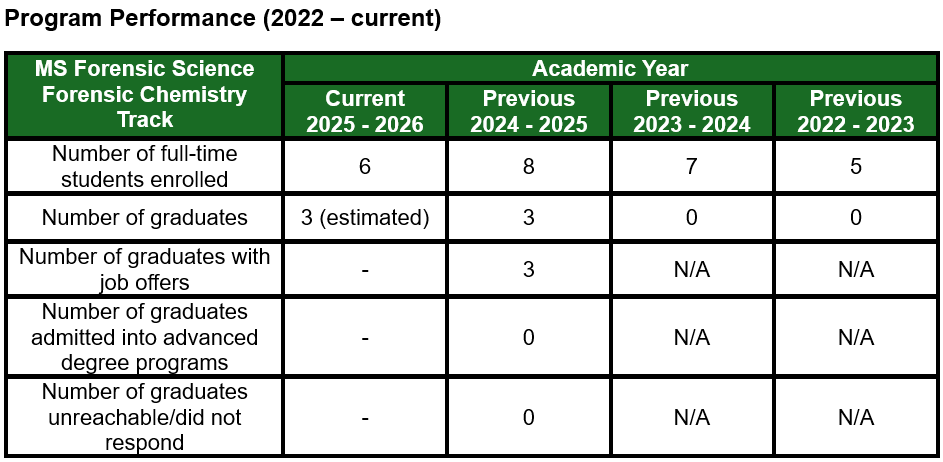
Program Performance (2005-2025)
Number of Entering Students: 59
Number of Graduates: 46
Number of Current Students: 8
Full-Time Students: 6
Part-Time Students: 2
Controlled Substances
Our work in this area is focused on developing tools to aid in the identification and characterization of novel psychoactive substances (NPS). We have developed a method for statistical comparison of mass spectra and are currently testing the method for the differentiation of positional isomers of ethylmethcathinone, fluormethamphetamine, fluoroisobutyryl fentanyl, and fluorobutyryl fentanyl. We have also demonstrated application of multivariate statistical models to classify various NPS according to structural subclass and are continuing this work to focus on fentanyl analogs.
Fire Debris Analysis
Our research in this area is focused on the development, refinement, and application of a kinetic-based model that can be used to generate chromatograms corresponding to an evaporated ignitable liquid. The model predicts the fraction of liquid remaining after evaporation and is broadly applicable to any ignitable liquid class. We are currently refining the model to improve predictive ability for gasoline and, in collaboration with Prof. Glen Jackson at West Virginia University, will investigate the effects of elevated temperature on the predictive ability. This work is currently funded by the National Institute of Justice (Award No. 2018-DU-BX-0225).
What are the basic application requirements?
To be eligible for consideration, applicants to the Forensic Science Masters program at Michigan State University must have a cumulative undergraduate GPA of at least 3.0. Please note that in recent years, successful applicants have generally had GPAs of 3.5 or better.
Applicants must have completed or be near completion of a Bachelors of Science degree from an accredited institution in a major appropriate to the concentration sought. For the forensic chemistry concentration, applicants should have a BS in Chemistry, Biochemistry, or Chemical Engineering.
Please view the Apply tab for more information.
Are there any undergraduate courses recommended in preparation for graduate study in forensic science, or for application to the program?
The coordinators of each concentration have identified a number of undergraduate courses that have proven helpful in pursuing graduate study in forensic science. These may already be included in an applicant's undergraduate program requirements; if not, it is suggested that these courses be taken as electives.
Forensic Chemistry: general and organic chemistry, biochemistry, quantitative analysis, instrumental methods, and physical chemistry. Laboratory research experience is preferred.
Forensic Anthropology: genetics, anatomy, human skeletal biology, general biology. Students interested in forensic anthropology should apply directly to the Anthropology PhD program and review information on the Department of Anthropology's Website.
Although my degree is in an unrelated field of study, I have taken quite a few science courses. Am I eligible to apply?
No. A strong science background is required for admission to the Forensic Science Masters program (as well as future employment in a crime laboratory), and an applicant's degree must be in a biological, natural, or physical science.
What is forensic science?
Forensic science is the application of scientific methods and processes to matters that involve crime or the public. There are many branches of forensic science because almost any science has some applications to public or criminal matters. Some of the main areas of forensic science include: Chemistry, Biology, Criminalistics, Pathology, Entomology, Psychology, Dentistry/Odontology, Engineering, Geology, and Anthropology
What does a forensic scientist do?
A forensic scientist is a scientist who usually works in a laboratory setting analyzing particular types of evidence, writing reports and testifying in court as an expert witness. In some cases, forensic scientists may attend crime or other incident scenes to help reconstruct the crime, or help in the recognition, collection, and preservation of evidence within their specialty. For example, a forensic anthropologist may be called upon to collect skeletal remains found in the woods. A forensic chemist may be asked to help in the processing of a clandestine drug laboratory. A trace evidence examiner may be asked to collect hairs and fibers and other traces from a homicide scene. Usually the crime scene component of the job of a forensic scientist is a relatively minor part of the duties.
Many forensic scientists work in forensic science (crime) laboratories. In the United States, there are more than 4000 crime laboratories, administered by the federal, state, or local governments or private industry. Most crime laboratories employ scientists in the areas of forensic chemistry (drugs, toxicology, trace evidence, explosives, fires, etc.) forensic biology (mainly DNA and body fluids and tissues), and criminalistics (fingerprints, questioned documents, firearms, and toolmarks).
What is the best route to prepare for a career as a forensic scientist?
In order to become a forensic scientist, one must become well grounded in the sciences that are important to that discipline. For example, a forensic pathologist must be educated in medicine and pathology. A forensic entomologist must be educated in the biological sciences and entomology.
If you wish to work in a forensic laboratory as a forensic chemist or biologist, you must have a thorough grounding in the basic sciences of chemistry, biology, physics, and mathematics. This can be achieved by obtaining a college degree in one of these sciences, making sure that the others are also covered. Courses in criminal justice may be useful to some extent, but a major in criminal justice is not adequate preparation for a career in forensic science. Forensic laboratory directors look first for a solid science background in deciding to hire a forensic scientist.
After obtaining this strong, broad science background, it is best to specialize in the areas of forensic science in which you are most interested. You may go on to medical school to become a forensic pathologist. You may wish to obtain a masters degree or Ph.D. in engineering to become a forensic engineer. To prepare for a career as a forensic scientist in a crime laboratory, it is recommended that you pursue a masters degree in forensic science.
Where is forensic science taught in the United States and around the world?
A list of forensic science programs worldwide can be found by going to the American Academy of Forensic Science webpage. There are a wide variety of programs at the bachelors and masters levels, and a few Ph.D. programs are listed as well. You should visit any school you contemplate attending, and discuss the program in detail with the faculty or administrator(s) before making a decision.
Where can I find more information about forensic science laboratories?
You can contact your local forensic laboratory or check out the website of the American Society of Crime Lab Directors (ASCLD) website.
What is a crime scene investigator?
Crime scene investigators or technicians are people who are trained to secure crime scenes and then search for, collect, and preserve physical evidence. This evidence is then transported to a forensic laboratory where forensic scientists perform examinations on the evidence. Crime scene technicians seldom do any analysis or processing of evidence, although some are trained in blood spatter analysis or fingerprint processing, etc.
Historically, crime scene investigators have been sworn police officers, but the present trend is toward "civilianizing" this unit - hiring and training non-police personnel. To prepare for a career in crime scene technology, a science background would be helpful, especially if there is some forensic science in it. Beyond that, you should pursue a college degree that is suitable for becoming a police officer. Law enforcement and criminal justice are examples of majors that would be helpful here.
What is a forensic anthropologist?
A forensic anthropologist is one who is educated in physical anthropology (particularly skeletal biology), archaeology, anatomy and allied sciences, usually with a Ph.D. There are few people who make a living solely as a forensic anthropologist. Instead, most are connected with universities and lend their talents to police agencies, prosecutors, defense attorneys or courts. Other forensic anthropologists work with state, regional or national government agencies and may be involved in the identification of victims of mass disasters or international war crimes. There is a certification process for the forensic anthropologist.
What is a forensic pathologist?
A forensic pathologist is a medical doctor whose job is to determine the cause and/or manner of death in cases of suspicious death. They are sometimes referred to as medical examiners or coroners, depending on the state. A forensic pathologist has a college degree, followed by a medical degree, and a 3-4 year residency in pathology. There are also some additional residencies in forensic pathology that can lead to certification as a forensic pathologist.
What is a forensic entomologist?
A forensic entomologist has extensive education and training in entomology, usually with a Ph.D. Almost no one makes a living in the United States solely with forensic entomology work. Instead, most are connected with a university and lend their talents to police agencies, prosecutors, defense attorneys, or courts.
What is a forensic (police) psychologist?
Many people wish to become involved in what has popularly become known as “forensic psychology”. They want to be involved in psychological crime scene reconstruction, psychological profiling and tracking serial criminals. Strictly speaking, this is not forensic psychology. This is police psychology or a form of criminal psychology. Forensic psychology deals with the determination of the ability of an accused person to assist in his own defense or stand trial.
There are few if any universities or colleges that have formal educational programs in police psychology, as most psychology departments consider this too applied. To get into this field, the best course of action is to get a strong clinical psychology background (a Ph.D. is preferred) and then obtain employment with a large police department or other law enforcement agency that has a behavioral science unit.
The job market for criminal psychologists is very small. We have very few serial rapists or murderers in the United States to profile, and the FBI behavioral science unit will perform this function at no cost for law enforcement agencies. Most police departments cannot afford to hire a police psychologist full time.
What is Criminology?
The term criminology is sometimes used interchangeably with forensic science. In fact, criminology is a social science that studies how and why people commit crimes, or crime causation. It is part of most criminal justice curricula in colleges and universities.
Program Information